
We're taking a break for a few days - all orders will be sent out on Monday the 14th September




What is the Major Lunar Standstill?
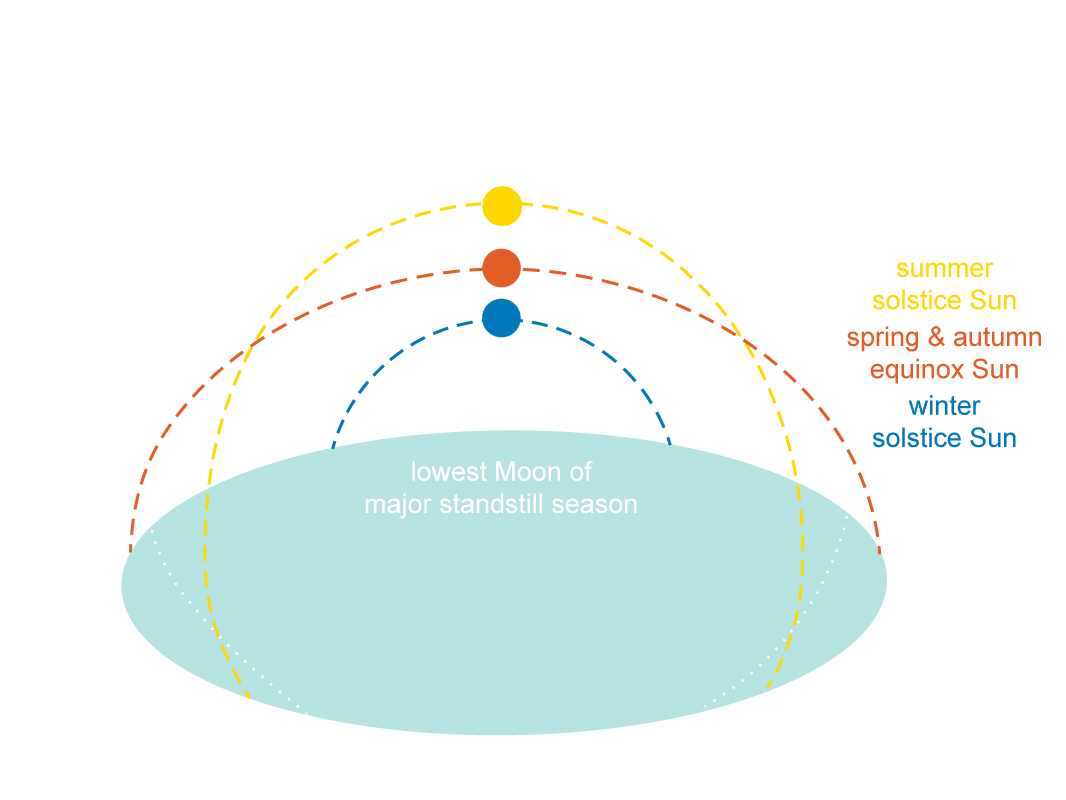
Major Lunar Standstill 2025
We are now in the peak of the Moon’s 18.6 year cycle when the Moon rises to her highest and lowest. By noticing these extremes, we have a unique opportunity to observe the Moon’s monthly cycle as well as her longer 18.6 yearly cycle.
Have you noticed the height of the Moon?
We’re now experiencing the Moon higher than the summer solstice Sun and lower than the winter solstice Sun. Each month, as the Moon goes round the Earth, she will be extremely low in Sagittarius/Capricorn. Two weeks later, she will be extremely high in Gemini/Cancer.
Over the next 9 years, these extremes will gradually decrease as we move towards the Minor Lunar Standstill when the range is at its minimum.
Why does the Moon have an 18.6 year cycle?
It’s the combination of the Earth’s tilt, the Moon’s tilt and the Sun’s gravitational pull.
To understand the Moon’s cycle, we’ll explore each of these in more detail. In this blog, we’ll begin by looking at the tilt of the Earth and how this affects our experience of the Sun.
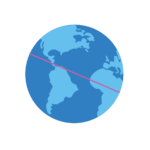
The Earth’s tilt
The Earth is tilted by 23.44˚on its axis. As the Earth orbits around the Sun, it’s tilt always points in the same direction so sometimes the Earth is tilted towards the Sun and sometimes away. This tilt affects how we experience the height of the Sun and gives us our seasons.
This diagram is for the northern hemisphere.
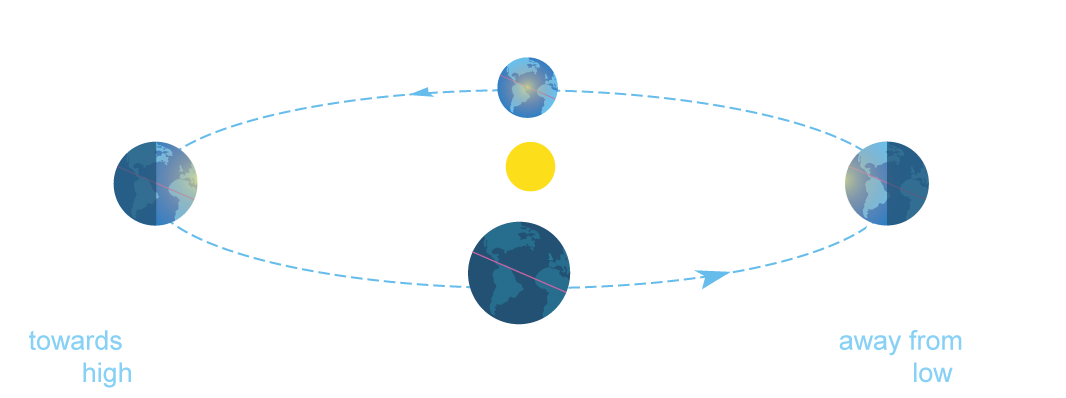
Solstice
When a hemisphere tilts towards the Sun, it experiences summer. The Sun is high in the sky and there is more direct sunlight and longer days. At the same time, the opposite hemisphere tilts away from the Sun and experiences winter with weaker sunlight and shorter days.
Equinox
During this time, neither hemisphere tilts toward the Sun so there is roughly equal day and night.
Conclusion
Throughout the year, the Earth’s tilt causes the Sun’s path in our sky to swing from low to high and back again. In our next blog, we’ll look at the Sun’s apparent path in our sky known as the ecliptic.
Look out for the Moon
You don’t need to understand astronomy to experience the height of the Moon. You can see the extremes when you look up at the sky. Every month, the Moon will swing from very high to very low.
Check your lunar diary or calendar to see when the Moon is in Gemini/Cancer as she’ll be high in the sky and Sagittarius/Capricorn when she’ll be low. Our Astro Moon Calendar 2025 shows the high and low Moons each month.
Animation
See our video on the Earth’s Tilt
You must be logged in to post a comment. If you do not have an account, register here.